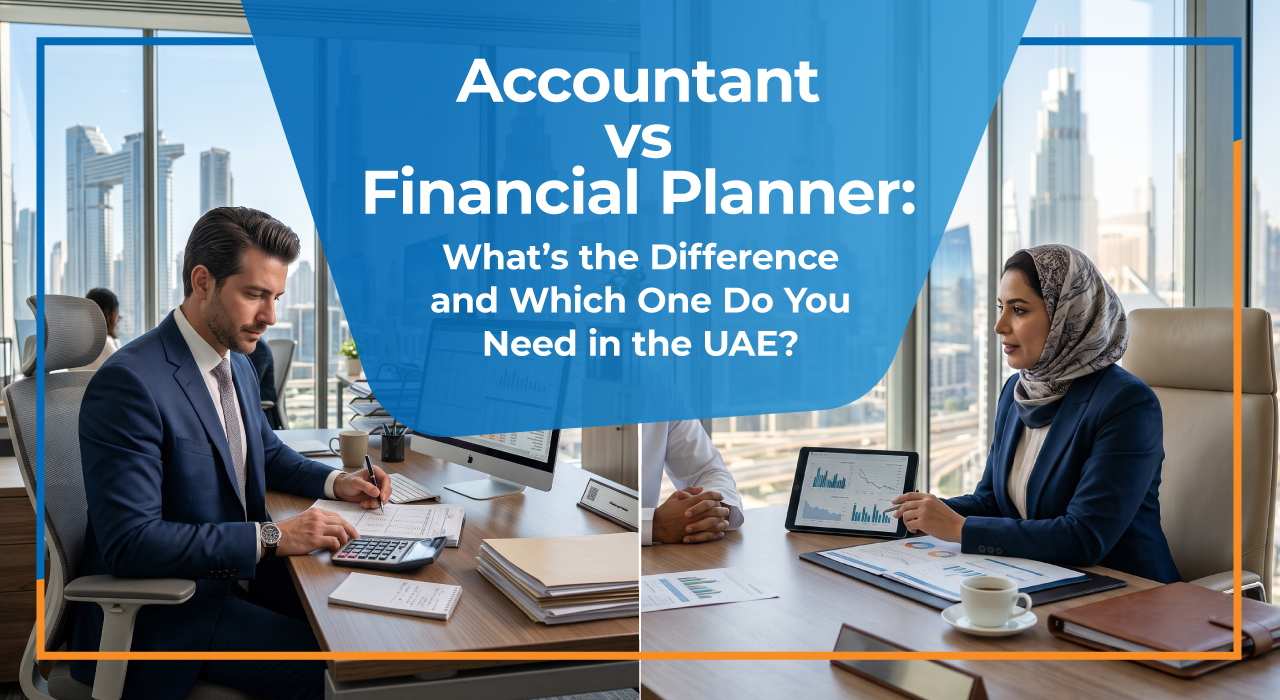
When people search for accountant vs financial planner, they are usually trying to answer one simple question: who should I speak to about my money? The confusion is understandable. Both professionals deal with finances. Both can offer guidance. Both may look at income, spending, assets, liabilities, and future decisions. But the role they play in your financial life is very different.
An accountant helps you understand, organise, and manage your financial records. Their work usually revolves around bookkeeping, reporting, tax support, compliance, and business performance. A financial planner, on the other hand, focuses on your future. They help you build a strategy around savings, investments, retirement, education planning, insurance, and long-term wealth goals.
In short, one looks closely at your financial reality today and the records behind it. The other looks at where you want to be tomorrow and how to get there.
That said, the choice is not always black and white. A salaried professional may only need a financial planner. A growing SME may first need an accountant. A business owner in the UAE may benefit from both – one to strengthen business finances and the other to structure personal wealth.
This blog explains the difference clearly, without jargon. We will look at what each professional does, where their roles overlap, when to hire one over the other, and how to decide what is right for your situation in the UAE.
Why People Confuse Accountants and Financial Planners
It is easy to see why these two roles get mixed up. Both are linked to money, decision-making, and financial advice. If you are not from a finance background, they can sound interchangeable.
But they are not.
An accountant is usually focused on financial records, reporting, compliance, taxation, and business numbers. A financial planner is focused on financial goals, wealth creation, risk management, and future planning.
Think of it this way:
- An accountant helps you understand what is happening in your finances
- A financial planner helps you decide what should happen next
That is the simplest way to separate the two.
The confusion becomes even more common in the UAE, where business owners and professionals often have layered financial lives. A person may have salary income, freelance income, family obligations abroad, investments, property plans, and a growing business – all at the same time. In that situation, it can be hard to know whether you need help with compliance, planning, or both.
What Does an Accountant Do?
An accountant’s role goes far beyond “doing the books.” A good accountant helps individuals and businesses make sense of financial information, stay compliant, and make decisions based on real numbers rather than assumptions.
For businesses, accountants are especially important because they create visibility. They tell you where the money is coming from, where it is going, what is profitable, what is not, and whether your records are in order.
An accountant typically helps with:
- Bookkeeping and maintaining financial records
- Preparing financial statements and management reports
- VAT and corporate tax support
- Cash flow tracking and budgeting
- Payroll accounting and reconciliations
- Expense classification and cost control
- Audit preparation and compliance support
- Business performance analysis
- Setting up accounting systems and processes
An accountant is often the person who brings order to financial chaos. If your books are behind, your reporting is inconsistent, or you are making decisions without reliable numbers, that is usually when accounting support becomes essential.

What Does a Financial Planner Do?
A financial planner works from a very different angle. Instead of focusing on what has already happened in your accounts or business records, they focus on your future financial life. Their role is less about compliance and more about planning. They take your current financial position and connect it to your long-term goals.
A financial planner typically helps with:
- Goal-based financial planning
- Retirement planning
- Investment planning
- Insurance and risk protection planning
- Education funding strategies
- Wealth building and long-term savings strategy
- Cash flow planning for personal goals
- Estate or legacy planning coordination
- Structuring finances around major life events
If an accountant tells you how your finances are performing today, a financial planner tells you whether your current decisions are taking you where you want to go. This is why a financial planner in the UAE can be especially useful for high-income professionals, expatriate families, and business owners who want to build long-term wealth rather than simply manage day-to-day finances.

Accountant vs Financial Planner: The Core Difference
The easiest way to understand the difference between an accountant and a financial planner is to compare their focus areas side by side.
| Area | Accountant | Financial Planner |
|---|---|---|
| Main focus | Financial records, tax, reporting, compliance | Long-term goals, savings, investments, retirement |
| Time frame | Present and past financial activity | Future financial planning |
| Common clients | Businesses, self-employed professionals, individuals with tax or reporting needs | Individuals, families, business owners, high-income professionals |
| Louis Hudson | Bookkeeping, statements, tax support, budgeting, cash flow reports | Retirement plans, investment strategy, protection planning, wealth goals |
| Main question answered | “What is happening financially and what needs to be managed correctly?” | “How should I use my money to reach future goals?” |
That difference matters because the wrong professional may not solve the actual problem in front of you.
Where Their Roles Overlap
Even though the two roles are different, there is some overlap. That overlap is one reason people often assume one professional can do the other’s job.
Both accountants and financial planners may discuss:
- income and expenses
- cash flow
- financial goals
- tax implications
- debt obligations
- business income or personal income planning
But the purpose of those conversations is different.
When You Need an Accountant
There are situations where the answer is very clearly “you need an accountant first.”
If your finances are disorganised, your records are incomplete, or your business decisions are being made without proper reporting, accounting support should come before financial planning.
You likely need an accountant if:
- Your business books are incomplete or messy
- You need help with VAT, corporate tax, or compliance
- You do not have reliable monthly financial reports
- Cash flow feels unpredictable, and you do not know why
- You want to understand business profitability properly
- You are preparing for an audit, loan application, or investor review
- You are setting up a company and need accounting systems in place
- You want better control over expenses, payroll, and reporting
For many businesses, accounting is the financial foundation. Without clean records and useful reporting, long-term planning becomes guesswork.
When You Need a Financial Planner
A financial planner becomes more relevant when the challenge is not financial disorder, but lack of direction. You may be earning well, saving something every month, and staying broadly on top of your finances – but still have no clear plan for retirement, investing, wealth building, or family security.
You likely need a financial planner if:
- You want to build a retirement strategy
- You have surplus income but no investment plan
- You want to create long-term wealth rather than simply save money
- You are planning for children’s education or other future expenses
- You want to review insurance and financial protection for your family
- You are approaching a major life event such as retirement, relocation, or business exit
- You want your money decisions to be aligned with long-term goals
This is especially true for professionals in the UAE who may not have a traditional pension structure and need to build their own long-term financial safety net.
Accountant vs Financial Planner for Business Owners
Business owners often ask whether they should hire an accountant or a financial planner, but in reality, they are the group most likely to need both.
That is because business owners do not have a clean line between personal finance and business finance. Their income, cash flow, taxes, savings, and future security are all tied to the business in some way.
A business owner may need an accountant for:
- bookkeeping and monthly reporting
- tax and compliance support
- profitability analysis
- cash flow management
- budgeting and forecasting
- finance systems and process improvements
- payroll and expense controls
The same business owner may need a financial planner for:
- deciding how much to draw from the business
- retirement planning outside the business
- investing surplus income
- building an emergency reserve
- protecting family finances
- education planning and long-term wealth structuring
If you own a business, relying on only one side can create blind spots. You may run a compliant company but fail to build personal wealth. Or you may have personal investment plans while the business itself lacks financial discipline.
Not sure whether you need a financial advisor or a financial accountant in the UAE? This blog explains the difference in simple terms and helps you choose the right expert for your business, money, and future goals.
https://nairnelliyatt.com/financial-advisor-or-financial-accountant/
Financial Planner UAE: Why It Matters for Residents and Expats
The UAE has a very specific financial environment. Many residents are expatriates. Some plan to retire elsewhere. Many business owners have cross-border family obligations, overseas property, or investments in more than one country.
That changes the way financial planning works.
A financial planner in the UAE can be particularly useful if your financial life includes:
- income in the UAE and family commitments abroad
- plans to retire outside the UAE
- school fee planning for children
- business income rather than a fixed salary
- investments across different markets
- a need to create retirement savings without an employer pension system
- wealth planning that has to work across countries
In such cases, financial planning is not just about investing money. It is about structuring your finances so they support your long-term life plans, wherever those plans eventually take you.
Accounting Consultant UAE: What This Role Usually Covers
The term accounting consultant UAE usually refers to someone who does more than basic bookkeeping. An accounting consultant is often brought in to improve the financial side of a business, not just maintain records.
That may include:
- setting up accounting systems for a new business
- reviewing and cleaning up financial records
- improving reporting formats and management dashboards
- analysing costs and profitability
- supporting VAT and corporate tax readiness
- helping business owners understand financial risks and opportunities
- strengthening finance processes and controls
This kind of support is especially useful for SMEs and growing companies that have outgrown basic bookkeeping but are not yet ready for a full internal finance team.
You may need an accounting consultant if:
- Your business is growing, but reporting is still weak
- Your accounts are technically maintained, but not useful for decision-making
- You need help improving systems, controls, and financial visibility
- Your business needs strategic finance support without hiring a full-time CFO
That is where an accounting consultant in the UAE can add value beyond day-to-day compliance.
Real-Life Scenarios: Who Should You Call?
Sometimes the easiest way to answer the accountant vs financial planner question is to look at the actual situation you are dealing with.
Scenario table
| Situation | Who is the better fit? |
|---|---|
| Your books are incomplete, and you need clean financial statements | Accountant |
| You want to know if you are saving enough for retirement | Financial planner |
| You need help with VAT, tax support, and compliance | Accountant |
| You received a large bonus and want to invest it wisely | Financial planner |
| Your business is growing, but cash flow is always tight | Accountant |
| You want to create a long-term plan for family wealth and education | Financial planner |
| You are a business owner trying to balance company growth with personal financial goals. | Both |
| You want to understand whether your pricing and margins are healthy | Accountant |
| You want to structure your finances for retirement in another country | Financial planner |
Mistakes People Make When Choosing Between the Two
Many people delay getting financial help because they are unsure who to approach. Others hire one professional and assume all financial needs will be covered. Both can lead to problems.
Common mistakes include:

Assuming tax filing equals financial management
Just because taxes are handled does not mean your finances are well managed.

Thinking a good salary automatically means you are financially secure
Without planning, high income can still lead to poor long-term outcomes.

Ignoring the link between business and personal finances
This is especially risky for business owners.

Waiting until a crisis appears
Good financial advice is most valuable before problems become urgent.

Expecting one advisor to solve every financial issue
Some problems are accounting issues. Some are planning issues. Some need both perspectives.
How to Decide Which One You Need Right Now
If you are still unsure, ask yourself a few practical questions.
Ask yourself:
- Is my current problem about financial records, tax, reporting, or compliance?
- Or is it about retirement, investing, savings goals, and long-term planning?
- Am I trying to solve a business finance issue, a personal wealth issue, or both?
- Do I need someone to tell me what my numbers mean today, or someone to help me build a roadmap for tomorrow?
Your answers will usually point you in the right direction.
A simple way to decide
| If your main concern is… | You probably need… |
|---|---|
| Bookkeeping, tax, compliance, financial reporting | Accountant |
| Retirement, investing, wealth planning, protection | Financial planner |
| Business performance plus personal financial planning | Both |
Final Thoughts
The debate around accountant vs financial planner is not really about choosing which profession is “better.” It is about understanding what kind of support your financial situation actually needs.
If your immediate challenge is business reporting, tax support, compliance, financial control, or cash flow visibility, an accountant is the right place to start.
If your main concern is retirement planning, investment strategy, family security, or building long-term wealth, a financial planner is likely the better fit.
And if you are a business owner, founder, or high-income professional whose personal future is closely tied to business income, you may need both. One helps you build a financially healthy present. The other helps you create a financially secure future. The key is not to wait until financial confusion turns into financial stress. The sooner you understand what kind of support you need, the easier it becomes to make smarter decisions with confidence.
Need Professional Support for Your Finances in the UAE?
Whether you are trying to improve business reporting, stay compliant, manage tax obligations, or build stronger financial systems, the right support can make a measurable difference. If you are looking for reliable accounting services in the UAE, work with NNCA, who understand both the numbers and the business decisions behind them.
If you are a business owner, entrepreneur, or growing company looking for dependable financial guidance, expert accounting services in the UAE like NNCA can help you strengthen reporting, improve visibility, and make more informed decisions for the road ahead.
Learn how outsourced CFO services in the UAE help businesses manage cash flow, improve financial planning, and make smarter growth decisions without hiring a full-time CFO.